Visible Universe History · Grade 10–11 Interactive Astronomy Guide
Humanity Has Reimagined the Universe for Thousands of Years
Every civilization inherited a sky. Every generation found new ways to explain it. Follow the changing models that transformed the universe from a mysterious canopy into an evolving, 13.8-billion-year-old cosmos—complete with verified NASA research, Wikipedia archives, and high school physics insights.
Before writing existed, humans tracked celestial rhythms to navigate seasons, migrations, and sacred ceremonies, perceiving the cosmos as an enchanted, living canopy.
Historical & Cultural Context
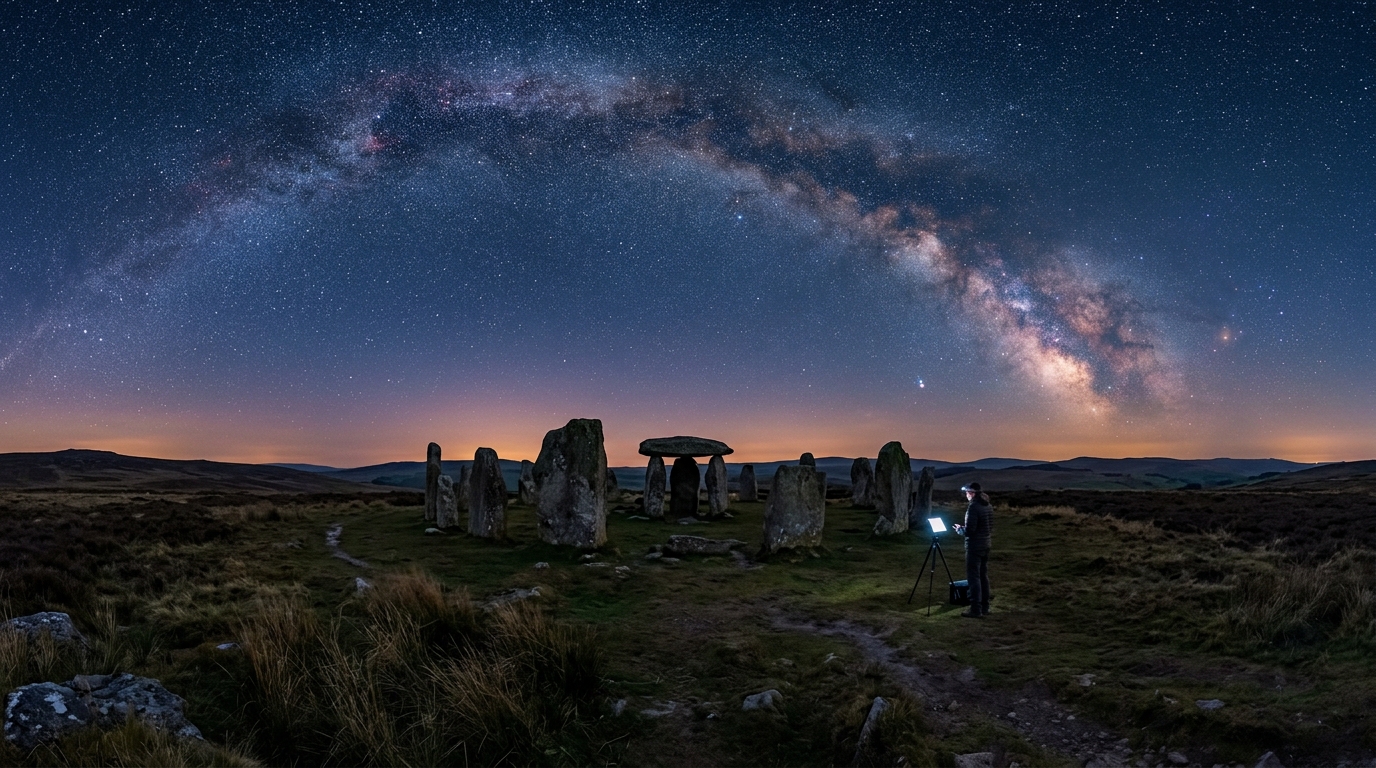
For tens of thousands of years, survival depended on reading celestial cycles. Lunar markings carved on bones at Blanchard (c. 28,000 BCE), solstice alignments at Göbekli Tepe and Stonehenge, and constellations painted in Upper Paleolithic caves reflect profound observational patience without formal geometric theories.
The Proposed Model
The night sky was perceived as an active vault overhead. The recurring paths of the Sun, Moon, and visible wandering stars marked cyclical time rather than passive mechanical orbits. Cosmological stories wove sky phenomena into community memory, ethics, and mythology.
What Observations Supported It?
Astronomical alignments of megalithic stone circles (summer/winter solstices), consistent 29.5-day lunar calendar tallies on Upper Paleolithic artifacts, and agricultural cycles tightly synchronized with the heliacal rising of star groups like the Pleiades.
What Evidence Challenged or Refined It?
No mathematical geometry or coordinate frameworks; observations were tied to local horizons and interpreted predominantly through mythological and ritual frameworks rather than predictive physical laws.
What Changed Next?
The rise of river valley civilizations (Mesopotamia, the Nile, Indus, and Yellow River) brought written records, systematic numerical sky-diaries, and state-sponsored cosmological systems.
Scientific Accuracy Note: Archaeologists caution against assuming a single universal prehistoric cosmology. Stonehenge and other megaliths demonstrate verified astronomical alignments, but specific theological beliefs of their builders remain prehistoric oral traditions.
Early urban civilizations developed sophisticated multi-layered cosmologies connecting the observed celestial paths with cosmic order, timekeeping, and state administration.
Historical & Cultural Context
Mesopotamian astronomers created the MUL.APIN star catalogues and 360-degree zodiac; Egyptian priests mapped decan stars to govern nocturnal hours; early Indian Vedic texts described Rta (cosmic rhythmic order); and Chinese observers documented eclipse omens and polar stars around the celestial pivot.
The Proposed Model
A layered universe where distinct zones housed the underworld, the terrestrial inhabited world, and multiple heavenly tiers. In Mesopotamia, three celestial paths belonged to the gods Anu, Enlil, and Ea; in Egypt, the sky goddess Nut arched over the earth god Geb; in China, the Gaitian model described a canopy covering a square earth.
What Observations Supported It?
Babylonian clay tablets documenting the 18-year Saros eclipse cycle and planetary synodic periods; Egyptian tomb ceilings featuring decanal star clocks; Chinese oracle bones recording supernovae and eclipses back to the 13th century BCE.
What Evidence Challenged or Refined It?
These traditions retained layered theological architectures and did not employ 3D Euclidean spherical kinematics or attempt to explain planetary distances physically.
What Changed Next?
Greek natural philosophers began asking whether celestial phenomena could be explained by underlying physical principles and pure geometric spheres without mythological intervention.
Scientific Accuracy Note: Mesopotamian, Egyptian, Indian, and Chinese cosmological models were distinct, highly evolved intellectual frameworks with different mathematical methods, not interchangeable steps in a single ladder.
Star clocks, decans, and the cosmological vault in ancient Egyptian temple architecture.
Student Inquiry & Exam FAQGrade 10–11
Key conceptual questions for Chapter 2: Ancient Cosmologies
CHAPTER 03·c. 1200–500 BCE
Ancient & Prehistoric
The Inhabited Disk Idea
What Did Ancient Societies Actually Model?
Civilizations:Early Mediterranean, Homeric Greece, Ancient Near East
Key Observers:Homer, Thales of Miletus (reconstructed), Anaximander
While some early poetic traditions depicted the human realm as a disk floating on waters, it was never a universal consensus, and natural observations soon prompted spherical models.
Historical & Cultural Context
Poetic cosmologies in early Greece (Homer, Hesiod) depicted the inhabited earth surrounded by the River Oceanus. However, Anaximander proposed Earth was a cylinder floating freely in space without support, while Thales saw it floating on water. Soon, travelers and mariners noticed empirical discrepancies.
The Proposed Model
A finite inhabited disk or circular landmass enclosed by an encircling ocean and surmounted by a sky dome. Celestial bodies rose from the eastern waters and set in the western abyss.
What Observations Supported It?
Locally, over small distances (a few kilometers), Earth appears planar to human sight; the horizon seems circular; water in ponds rests flatly in gravity's local normal.
What Evidence Challenged or Refined It?
Fails to explain why ships disappear hull-first over the horizon, why the altitude of Polaris changes when traveling north or south, and why Earth's shadow cast upon the Moon during an eclipse is invariably circular.
What Changed Next?
Philosophers in Magna Graecia and Athens gathered empirical evidence that could only be satisfied if Earth was a physical sphere suspended in space.
Scientific Accuracy Note: Historians of science emphasize that the 'Flat Earth myth'—the claim that medieval scholars thought Earth was flat until Columbus—is a 19th-century fabrication. Educated thinkers from Aristotle onward understood Earth was spherical.
Greek thinkers proved Earth is a sphere through lunar eclipse shadows and stellar elevations, and calculated its circumference with astonishing precision.
Historical & Cultural Context
In 'On the Heavens' (De Caelo, c. 350 BCE), Aristotle presented physical and observational proofs for a spherical Earth. In 240 BCE, , head librarian of Alexandria, measured solar angles at Syene (Aswan) and Alexandria at noon on the summer solstice, calculating Earth's circumference to within ~1–2% of the true value.
The Proposed Model
Earth is a spherical globe resting unsupported at the physical center of the universe, surrounded by nested concentric celestial spheres. Gravity pulls heavy elements toward the center of the sphere.
What Observations Supported It?
1. Lunar eclipses always show a circular shadow regardless of Moon angle.
2. Southern stars (like Canopus) become visible as one travels south, while northern stars sink.
3. Ships sailing away disappear hull-first, masts last.
4. ' solar shadow angle difference (7.2° = 1/50 of a circle) over 5,000 stadia.
What Evidence Challenged or Refined It?
Assumed Earth was fixed and stationary at the center of the cosmos. Aristotelian physics could not conceive of an Earth moving through space without people and atmosphere flying off.
What Changed Next?
Astronomers needed geometric models to explain the baffling irregular motions of planets, which periodically slowed, stopped, and moved backwards (retrograde motion).
Scientific Accuracy Note: Eratosthenes measured the sun angle difference as 7°12' (1/50th of 360°). Depending on which Attic or Egyptian stadion he used (157.5m to 185m), his result was between 39,375 km and 46,620 km, remarkably close to Earth's equatorial circumference of 40,075 km.
Mathematical breakdown of Eratosthenes' solar shadow measurement between Syene and Alexandria.
Student Inquiry & Exam FAQGrade 10–11
Key conceptual questions for Chapter 4: The Spherical Earth
CHAPTER 05·c. 380 BCE
Classical Antiquity
Homocentric Spheres
Eudoxus and the Geometry of Retrograde Motion
Civilizations:Classical Greece (Cnidus & Athens)
Key Observers:Eudoxus of Cnidus (c. 390–337 BCE), Callippus, Aristotle
Grade 10–11 Concept Spotlight (NASA & Wikipedia):
Eudoxus introduced nested, concentric rotating spheres to explain the mysterious looping backward motions (retrograde loops) of the planets.
Historical & Cultural Context
Plato challenged Greek mathematicians: 'By the assumption of what uniform and orderly motions can the apparent motions of the planets be accounted for?' Eudoxus, an exceptional geometer, solved this with an ingenious mechanical arrangement of nested spheres rotating on tilted axes.
The Proposed Model
Concentric homocentric crystal spheres, all sharing Earth as their common center. Each planet was carried by three or four nested spheres rotating with uniform speed on different axes. The combination of rotations traced a figure-eight path called the 'hippopede' (horse fetter), recreating apparent retrograde loops.
What Observations Supported It?
Qualitatively accounted for the fact that planets stop and temporarily reverse direction against the background constellations of the zodiac.
What Evidence Challenged or Refined It?
Because all spheres were strictly concentric with Earth, a planet's distance from Earth could never vary. Thus, Eudoxus could not explain why planets (especially Mars and Venus) appear noticeably brighter during retrograde motion, nor why solar eclipses are sometimes annular and sometimes total.
What Changed Next?
Hellenistic astronomers realized planets must physically change their distance from Earth, leading to eccentric circles, , and radical hypotheses.
Scientific Accuracy Note: Eudoxus' model was purely mathematical, while Aristotle later treated the spheres as physical, mechanical crystalline shells, complicating the system into 55 interlocking spheres.
Geometric analysis of the nested homocentric spheres and the hippopede curve.
Student Inquiry & Exam FAQGrade 10–11
Key conceptual questions for Chapter 5: Homocentric Spheres
CHAPTER 06·c. 270 BCE
Classical Antiquity
Aristarchus' Early Sun-Centred Cosmos
The Audacious Third-Century BCE Heliocentric Proposal
Civilizations:Hellenistic Greece & Alexandria
Key Observers:Aristarchus of Samos (c. 310–230 BCE), Archimedes (The Sand Reckoner), Seleucus of Seleucia
Grade 10–11 Concept Spotlight (NASA & Wikipedia):
Eighteen centuries before Copernicus, Aristarchus proposed that the Sun, not Earth, rests at the center, with Earth both rotating daily and orbiting the Sun yearly.
Historical & Cultural Context
In 'On the Sizes and Distances of the Sun and Moon', Aristarchus calculated through lunar phase geometry that the Sun is vastly larger than Earth. Concluding it was illogical for a colossal Sun to orbit a tiny Earth, he formulated a complete model, documented by Archimedes in 'The Sand Reckoner'.
The Proposed Model
The Sun and fixed stars remain motionless; Earth rotates daily on its axis and orbits the Sun annually along a circular path. The fixed stars are at such an immense distance that Earth's orbit subtends no observable angle.
What Observations Supported It?
Geometric measurements showed the Sun was roughly 20 times farther than the Moon and vastly larger in physical volume (though his angular measurement error underestimated the true scale, his conceptual deduction held).
What Evidence Challenged or Refined It?
Rejected by contemporary astronomers because Greek observers could detect no (the shift in apparent star positions as Earth moves). Without telescopes, stars appeared as points with zero measurable shift. Ancient physics also had no concept of inertia to explain why falling objects do not fly backward.
What Changed Next?
Without observational evidence for , astronomers preferred mathematically refined Earth-centered models that accurately predicted planetary positions, culminating in Ptolemy.
Scientific Accuracy Note: Archimedes explicitly confirms Aristarchus' hypothesis: 'Aristarchus of Samos brought out a book consisting of certain hypotheses... that the fixed stars and the Sun remain unmoved, that the Earth revolves about the Sun in the circumference of a circle.'
Documentation of Aristarchus' heliocentric model recorded in Archimedes' Sand Reckoner.
Student Inquiry & Exam FAQGrade 10–11
Key conceptual questions for Chapter 6: Aristarchus' Early Sun-Centred Cosmos
CHAPTER 07·c. 150 CE
Classical Antiquity
Ptolemy's Geocentric Framework
Epicycles, Deferents, and 1,400 Years of Planetary Prediction
Civilizations:Roman Empire, Hellenistic Egypt
Key Observers:Claudius Ptolemy (c. 100–170 CE), Hipparchus of Nicaea (predecessor)
Grade 10–11 Concept Spotlight (NASA & Wikipedia):
Ptolemy assembled Greek mathematical astronomy into the Almagest, constructing a predictive geocentric system of and deferents that endured for fourteen centuries.
Historical & Cultural Context
Working in Roman Alexandria around 150 CE, Ptolemy synthesized five centuries of Babylonian observational data and Greek geometry into the 13-volume 'Mathematike Syntaxis' (later known by its Arabic title, 'Almagest', 'The Greatest').
The Proposed Model
Earth rests stationary near the center of the cosmos. Each planet moves in a small circle called an ****, whose center revolves along a larger circle called the ****. To match varying speeds, Ptolemy introduced the **eccentric** (off-center Earth) and the **equant** point (from which motion appears uniform).
What Observations Supported It?
It accurately predicted the positions of the planets, Sun, and Moon, explained brightness variations during retrograde motion, and enabled reliable navigation, calendar calculation, and eclipse prediction.
What Evidence Challenged or Refined It?
Geometrically complex and philosophically controversial; the equant violated the classical ideal of uniform circular motion around a real physical center. It required separate, uncoupled mathematical models for each planet.
What Changed Next?
Over the Middle Ages, astronomers across Islamic observatories and European universities rigorously recalculated, criticized, and refined Ptolemy's parameters, setting the stage for Copernicus.
Scientific Accuracy Note: Ptolemy did not invent epicycles (Apollonius and Hipparchus used them earlier), but he perfected the mathematical machinery and introduced the equant, achieving unprecedented predictive fidelity.
Astronomers in Baghdad, Maragha, Samarkand, Ujjain, and Kaifeng revolutionized observational instruments, developed trigonometry, and critiqued Ptolemy with ingenious devices like the Tusi Couple.
Historical & Cultural Context
While Europe preserved texts in monasteries, the Islamic Golden Age established grand state observatories (Maragha, Samarkand). Ibn al-Haytham wrote 'Doubts on Ptolemy' (Al-Shukuk 'ala Batlamyus); Aryabhata in India proposed Earth's axial rotation and calculated $\pi$; and Chinese astronomers catalogued the SN 1054 supernova (Crab Nebula).
The Proposed Model
Mathematical models designed to eliminate Ptolemy's problematic equant while retaining physical realism. Nasir al-Din al-Tusi developed the **Tusi Couple**: a geometric device where a small circle rotates inside another twice its diameter, producing linear back-and-forth motion from pure circular rotations.
What Observations Supported It?
Astronomers achieved sub-arcminute measurement precision with giant sextants, updated solar apogee drift (al-Battani), mapped over 1,000 stars with unprecedented precision (Ulugh Beg's Zij-i Sultani), and corrected Ptolemy's lunar distance errors.
What Evidence Challenged or Refined It?
Most medieval astronomers remained committed to an Earth-centered physics, finding no observational evidence that the heavy Earth was hurtling through empty space.
What Changed Next?
Nicolaus Copernicus incorporated mathematical devices directly adapted from the Maragha school (including the Tusi Couple and Urdi lemma) into his revolutionary Sun-centered model in 1543.
Scientific Accuracy Note: Historians of science (such as Willy Hartner and George Saliba) demonstrated that Copernicus' diagrams of the lunar and planetary mechanisms in 'De revolutionibus' use identical lettering and geometry to Nasir al-Din al-Tusi's and Ibn al-Shatir's Arabic manuscripts.
Aryabhata's Aryabhatiya (499 CE), axial rotation of the Earth, and planetary ephemerides.
Student Inquiry & Exam FAQGrade 10–11
Key conceptual questions for Chapter 8: Astronomy Across the Medieval World
CHAPTER 09·1543 CE
Scientific Revolution
Copernicus & the Sun-Centred System
The Mathematical Realignment of the Planets
Civilizations:Renaissance Poland & Europe
Key Observers:Nicolaus Copernicus (1473–1543), Georg Joachim Rheticus
Grade 10–11 Concept Spotlight (NASA & Wikipedia):
In De revolutionibus (1543), Copernicus placed the Sun near the center of the cosmos, showing that planetary retrograde motion is a natural optical illusion caused by Earth's orbital motion.
Historical & Cultural Context
Troubled by the equant's violation of uniform circular motion, Polish canon Nicolaus Copernicus worked for three decades on a mathematical alternative. Published on his deathbed in 1543, 'De revolutionibus orbium coelestium' reorganized the cosmos with mathematical elegance.
The Proposed Model
The Sun is located at the center of the planetary orbits. Earth is simply the third planet, executing three motions: daily axial rotation, annual orbital revolution around the Sun, and axial precession. Planetary speeds decrease naturally with distance from the Sun.
What Observations Supported It?
1. Naturally explained retrograde motion: when faster-moving Earth overtakes slower outer planets (Mars, Jupiter, Saturn), they appear to loop backward against distant stars.
2. Deduced the true relative distances and periods of all planets for the first time.
3. Explained why Mercury and Venus never stray far from the Sun in the sky.
What Evidence Challenged or Refined It?
Still bound to the classical dogma that heavenly bodies must move in uniform circular paths, Copernicus was forced to retain small (48 in total) to match observations, and his predictions were initially no more accurate than Ptolemy's.
What Changed Next?
Tycho Brahe gathered naked-eye observations an order of magnitude more precise, which Johannes Kepler used to shatter the dogma of circular orbits.
Scientific Accuracy Note: Copernicus' system was not strictly heliocentric in the modern sense; the geometric center of his planetary circles was not the physical body of the Sun, but an empty point in space near the Sun.
Tycho Brahe achieved unprecedented naked-eye observational precision and proposed an influential hybrid model: Earth remains stationary while planets orbit the Sun, which orbits Earth.
Historical & Cultural Context
From his state-of-the-art observatory Uraniborg on the island of Hven, Danish nobleman Tycho Brahe measured celestial positions with precision under 2 arcminutes. His discovery of the 1572 supernova and the 1577 comet proved that the heavens are not immutable crystalline spheres, but change and allow bodies to pass through them.
The Proposed Model
The **Tychonic System**: Earth is stationary at the center, orbited by the Moon and the Sun. Meanwhile, all other planets (Mercury, Venus, Mars, Jupiter, Saturn) orbit the moving Sun. Mathematically, it is geometrically identical to the Copernican system for planetary positions, but avoids Earth's motion.
What Observations Supported It?
1. Consistent with the stubborn failure to measure any with naked-eye instruments.
2. Preserved the intuitive Aristotelian physics of a stationary Earth.
3. Accounted for planetary brightness variations and retrograde loops identically to Copernicus.
What Evidence Challenged or Refined It?
An awkward hybrid compromise: why should five planets be bound to the Sun while the Sun is bound to Earth? It could not provide a unified physical dynamical mechanism.
What Changed Next?
On his deathbed in Prague, Tycho entrusted his priceless Mars observation notebooks to his young assistant, Johannes Kepler, who used them to uncover the true laws of planetary motion.
Scientific Accuracy Note: Tycho calculated that if Copernicus were right and stars showed no parallax, the stars would have to be mind-bogglingly distant, and based on their apparent optical disk size, individual stars would need to be larger than Earth's entire orbit—an objection valid until the wave theory of light proved star disks are Airy diffraction patterns.
The observational achievements of Tycho Brahe and the geometry of the Tychonic planetary system.
Student Inquiry & Exam FAQGrade 10–11
Key conceptual questions for Chapter 10: Tycho Brahe & the Hybrid Cosmos
CHAPTER 11·1609–1619 CE
Scientific Revolution
Kepler's Elliptical Orbits
The Three Laws that Unveiled Real Planetary Motion
Civilizations:Holy Roman Empire (Prague & Linz)
Key Observers:Johannes Kepler (1571–1630)
Grade 10–11 Concept Spotlight (NASA & Wikipedia):
By analyzing Tycho's Mars observations, Kepler broke the 2,000-year dogma of circular motion, proving planets move in ellipses with varying speeds governed by exact mathematical laws.
Historical & Cultural Context
Kepler spent eight years trying to fit Tycho's Mars data to circles. A discrepancy of just 8 arcminutes—an error impossible in Tycho's observations—forced Kepler to abandon circular orbits: 'If I had believed that we could ignore these eight minutes, I would have patched up my hypothesis... But since they could not be ignored, these eight minutes alone opened the way to a complete revolution in astronomy.'
The Proposed Model
**Kepler's Three Laws**:
1. **First Law (1609)**: Planets move in ellipses with the Sun at one focus.
2. **Second Law (1609)**: A line connecting a planet to the Sun sweeps out equal areas in equal intervals of time (faster at perihelion, slower at aphelion).
3. **Third Law (1619)**: The square of the orbital period ($P^2$) is directly proportional to the cube of the semi-major axis ($a^3$).
What Observations Supported It?
Accurately predicted the 1631 transit of Mercury across the Sun (observed by Pierre Gassendi), proving planetary positions with tenfold greater precision than any prior table in human history.
What Evidence Challenged or Refined It?
described *how* planets move geometrically and kinematically, but could not explain *why*—what invisible physical force pulled them into ellipses and governed their speeds.
What Changed Next?
Isaac Newton formulated universal gravitation, deriving all three of Kepler's empirical laws from a single inverse-square gravitational force.
Scientific Accuracy Note: Kepler initially sought mystical geometric harmonies (the nested Platonic solids in 'Mysterium Cosmographicum'), but his intellectual honesty drove him to follow observational empirical data wherever it led, birthing modern astrophysics.
Official NASA guide to Kepler's three laws of orbital mechanics and elliptical orbital geometry.
Student Inquiry & Exam FAQGrade 10–11
Key conceptual questions for Chapter 11: Kepler's Elliptical Orbits
CHAPTER 12·1610 CE
Scientific Revolution
Galileo & the Telescopic Universe
New Moons, Venus Phases, and Empirical Shocks
Civilizations:Republic of Venice & Grand Duchy of Tuscany (Italy)
Key Observers:Galileo Galilei (1564–1642)
Grade 10–11 Concept Spotlight (NASA & Wikipedia):
Turning his improved spyglass to the heavens in 1609, Galileo shattered classical cosmology by discovering moons orbiting Jupiter, mountains on the Moon, and full phases of Venus.
Historical & Cultural Context
In Venice and Padua, Galileo improved Hans Lippershey's spyglass into a 20x astronomical telescope. In March 1610, he published 'Sidereus Nuncius' (The Starry Messenger), stunning the world with discoveries that directly contradicted Aristotelian dogma.
The Proposed Model
Direct empirical revelations supporting the Copernican architecture:
1. **Phases of Venus**: Venus displays a complete cycle of phases (crescent, gibbous, full) with size inversely proportional to illumination, impossible in Ptolemy's model and proving Venus circles the Sun.
2. **Moons of Jupiter**: Four moons (Io, Europa, Ganymede, Callisto) clearly orbit Jupiter, proving Earth is not the sole center of all cosmic revolution.
3. **Lunar mountains and sunspots**: Celestial bodies are not pristine, unblemished crystalline spheres, but geological worlds with rugged terrains.
What Observations Supported It?
Direct optical observations witnessed through telescopes by astronomers across Europe, including Jesuit mathematicians at the Collegio Romano.
What Evidence Challenged or Refined It?
Telescopic observations alone could not physically prove that Earth was in motion, nor explain why people did not feel the motion, leading to the Inquisition's 1633 trial of Galileo for defending Copernicanism.
What Changed Next?
Galileo formulated the law of inertia and classical relativity in 'Dialogue Concerning the Two Chief World Systems' (1632), laying the foundation for Newton's synthesis.
Scientific Accuracy Note: While Venus phases ruled out Ptolemy's pure geocentric model, they were compatible with Tycho Brahe's geoheliocentric system. Thus, Galileo's Venus observations proved heliocentrism over Ptolemy, but did not immediately rule out the Tychonic alternative until Newtonian physics triumphed.
Documentation of Galileo's Sidereus Nuncius observations: Jupiter's moons, Venus phases, and lunar craters.
Student Inquiry & Exam FAQGrade 10–11
Key conceptual questions for Chapter 12: Galileo & the Telescopic Universe
CHAPTER 13·1687 CE
Scientific Revolution
Newton's Universal Gravitation
One Law for the Apple and the Moon
Civilizations:England & Western Europe
Key Observers:Isaac Newton (1642–1727), Edmond Halley, Robert Hooke
Grade 10–11 Concept Spotlight (NASA & Wikipedia):
Newton's Principia (1687) united terrestrial physics and celestial motions under universal gravitation, demonstrating that falling apples and orbiting planets obey identical physical laws.
Historical & Cultural Context
Encouraged by Edmond Halley, Isaac Newton published 'Philosophiae Naturalis Principia Mathematica'. Newton formulated three laws of motion, invented calculus, and derived Kepler's orbital laws directly from an inverse-square gravitational attraction.
The Proposed Model
Every mass in the universe attracts every other mass with a force directly proportional to the product of their masses and inversely proportional to the square of the distance between them:
$$F = G \frac{m_1 m_2}{r^2}$$
Planets orbit because they are in continuous free-fall around the Sun; their forward velocity keeps them from crashing inward.
What Observations Supported It?
1. Mathematical derivation of all three orbital laws.
2. Explanation of ocean tides caused by gravitational pulls of Moon and Sun.
3. Accurate prediction of the return of Halley's Comet in 1758.
4. Discovery of Neptune in 1846 by Le Verrier and Adams through perturbations in Uranus' orbit.
What Evidence Challenged or Refined It?
Newton could not explain *how* gravity acted instantaneously across empty space ('action at a distance'). Furthermore, precise 19th-century measurements revealed that Mercury's perihelion was precessing by an extra 43 arcseconds per century that Newton's equations could not account for.
What Changed Next?
In 1915, Albert Einstein replaced gravitational force with the curvature of four-dimensional spacetime in .
Scientific Accuracy Note: Newton's famous cannon thought experiment illustrated the continuity between terrestrial projectiles and celestial satellites: firing a cannonball fast enough (~7.9 km/s on Earth) makes its trajectory curve at the same rate Earth curves beneath it, creating an artificial satellite.
Official NASA guide to Newtonian gravitational physics, orbital velocity, and celestial mechanics.
Student Inquiry & Exam FAQGrade 10–11
Key conceptual questions for Chapter 13: Newton's Universal Gravitation
CHAPTER 14·1785–1838 CE
Stellar & Early Modern
Beyond the Solar System
Mapping the Milky Way and the First Star Distances
Civilizations:Great Britain & Germany
Key Observers:William Herschel (1738–1822), Caroline Herschel (1750–1848), Friedrich Bessel (1784–1846), Thomas Henderson, Friedrich von Struve
Grade 10–11 Concept Spotlight (NASA & Wikipedia):
William and Caroline Herschel star-gauged the Milky Way as a flattened stellar disk, and Friedrich Bessel measured the first in 1838, proving stars are suns light-years away.
Historical & Cultural Context
With colossal 20-foot and 40-foot reflecting telescopes, the Herschels counted stars along 683 sightlines, deducing that our galaxy is a flattened 'grindstone' of suns. In 1838, Bessel measured the minuscule shift of 61 Cygni ($0.314''$), proving it lay 10.3 light-years away and finally verifying Aristarchus' missing .
The Proposed Model
The universe is not confined to the solar system. The Sun is one of millions of stars arranged in a flattened disk—the Milky Way. Interstellar space is vast, measured in trillions of kilometers (light-years).
What Observations Supported It?
1. Stellar star-counts revealing the disk-like concentration of stars along the Milky Way band.
2. Friedrich Bessel's measurement of 61 Cygni's trigonometric (1838).
3. Thomas Henderson's measurement of Alpha Centauri's (1839).
What Evidence Challenged or Refined It?
Because interstellar dust was unknown, Herschel's star counts were dimmed by obscuring dust clouds, leading him to wrongly place our Sun near the center of the Milky Way. Whether 'spiral nebulae' were within our galaxy or external 'island universes' remained unresolved.
What Changed Next?
In 1920, the Great Debate erupted over whether the Milky Way encompassed the entire cosmos, until Edwin Hubble used Cepheid variables to prove spiral nebulae are distant external galaxies.
Scientific Accuracy Note: Herschel's 'grindstone' model measured only about 8,000 light-years across. We now know interstellar dust extinction blinded early astronomers to 90% of the Milky Way, which is actually over 100,000 light-years in diameter.
At the Smithsonian in 1920, astronomers debated whether the Milky Way is the whole universe or merely one island galaxy among millions; Hubble settled it with Cepheid variable stars in 1924.
Historical & Cultural Context
On April 26, 1920, Harlow Shapley argued the Milky Way was immense (300,000 light-years across) and contained all observed spiral nebulae. Heber Curtis countered that the Milky Way was smaller, and spiral nebulae like Andromeda were independent external galaxies ('island universes', an idea tracing back to Immanuel Kant).
The Proposed Model
The cosmos contains billions of distinct, vast stellar systems (galaxies) separated by millions of light-years of intergalactic space. The Milky Way is merely one ordinary spiral galaxy in an ocean of galaxies.
What Observations Supported It?
In October 1923, Edwin Hubble used the 100-inch Hooker Telescope at Mount Wilson to identify a Cepheid variable star (V1) in the Andromeda 'Nebula'. Applying Henrietta Leavitt's period-luminosity relation, Hubble calculated Andromeda was nearly 1 million light-years away (modern value: 2.5 million ly), far outside the Milky Way.
What Evidence Challenged or Refined It?
Knowing galaxies were distant did not yet reveal whether the universe was static, eternal, expanding, or evolving over time.
What Changed Next?
Astronomers measuring galaxy spectral lines discovered that almost all distant galaxies are and rushing away from us, revealing an expanding universe.
Scientific Accuracy Note: Henrietta Swan Leavitt's 1912 discovery that brighter Cepheids pulse more slowly provided the essential 'standard candle' without which Hubble could never have measured extragalactic distances.
How Edwin Hubble's photograph of Cepheid V1 in M31 proved Andromeda is an independent galaxy.
Student Inquiry & Exam FAQGrade 10–11
Key conceptual questions for Chapter 15: The Scale of the Universe
CHAPTER 16·1915–1917 CE
Relativity & Galaxies
Einstein's Curved Spacetime
General Relativity and the Fate of a Static Cosmos
Civilizations:Germany & Switzerland
Key Observers:Albert Einstein (1879–1955), Arthur Eddington, Karl Schwarzschild
Grade 10–11 Concept Spotlight (NASA & Wikipedia):
Einstein revealed that gravity is not an invisible force, but the curvature of four-dimensional spacetime caused by mass and energy, transforming cosmology into an exact physical science.
Historical & Cultural Context
In November 1915, Albert Einstein published the field equations of . In 1917, seeking to apply his equations to the entire universe, Einstein was troubled to find that gravity should cause all matter to collapse inward. Believing the cosmos was eternal and static, he introduced the **cosmological constant** ($\Lambda$) to counteract gravity.
The Proposed Model
Matter and energy tell spacetime how to curve; curved spacetime tells matter how to move ($G_{\mu\nu} + \Lambda g_{\mu\nu} = \frac{8\pi G}{c^4} T_{\mu\nu}$). The universe is a continuous 4D geometric manifold whose global geometry is determined by its total density.
What Observations Supported It?
1. Exactly explained Mercury's anomalous 43 arcsecond/century perihelion precession.
2. Arthur Eddington's 1919 solar eclipse expedition confirmed that the Sun's mass bends starlight by exactly 1.75 arcseconds.
3. Gravitational of light confirmed in laboratory and stellar observations.
What Evidence Challenged or Refined It?
Einstein's static model was unstable: the slightest perturbation would cause it to either rapidly expand or collapse. Einstein later called the cosmological constant his 'greatest blunder' when cosmic expansion was confirmed.
What Changed Next?
Alexander Friedmann and Georges Lemaître realized that Einstein's unadulterated equations naturally predicted an expanding or contracting universe.
Scientific Accuracy Note: Popular visual depictions often show spacetime as a rubber sheet bent downward by gravity; scientifically, curvature occurs in both space and time dimensions, and geodesics represent straight paths through curved 4D spacetime.
The foundations of general relativity, spacetime curvature, and the 1919 Eddington starlight deflection test.
Student Inquiry & Exam FAQGrade 10–11
Key conceptual questions for Chapter 16: Einstein's Curved Spacetime
CHAPTER 17·1922–1927 CE
Cosmology & Big Bang
Lemaître, Friedmann & the Expanding Universe
The Theoretical Discovery of Dynamic Space
Civilizations:Soviet Union (Saint Petersburg) & Belgium (Leuven)
Key Observers:Alexander Friedmann (1888–1925), Georges Lemaître (1894–1966), Willem de Sitter
Grade 10–11 Concept Spotlight (NASA & Wikipedia):
Friedmann and Lemaître solved Einstein's gravitational equations without a static fudge-factor, proving mathematically that space itself can expand, contract, or evolve from an initial point.
Historical & Cultural Context
In 1922, Russian mathematician Alexander Friedmann published non-static solutions to . In 1927, Belgian priest and theoretical physicist Georges Lemaître independently derived expanding universe solutions and proposed that the cosmos began in a primeval explosion—the 'primeval atom' (l'atome primitif).
The Proposed Model
The universe is homogeneous and isotropic on large scales (the Cosmological Principle). The metric of space is dynamic: the physical distance between unaccelerated galaxies increases as the **cosmic scale factor** $a(t)$ grows over cosmic time. Space itself is stretching, not galaxies flying through static empty space.
What Observations Supported It?
Provided the exact mathematical foundation needed to interpret the astronomical being observed by Vesto Slipher and Edwin Hubble.
What Evidence Challenged or Refined It?
Initially dismissed by Einstein ('Your mathematics is correct, but your physics is abominable') until astronomical observational data forced the scientific community to accept expansion.
What Changed Next?
Edwin Hubble and Milton Humason gathered the systematic observational data that proved cosmic expansion in 1929.
Scientific Accuracy Note: In 2018, the International Astronomical Union (IAU) voted to officially rename the expansion law the **Hubble–Lemaître Law**, recognizing Georges Lemaître's 1927 publication where he calculated the expansion rate two years before Hubble.
In 1929, Hubble and Humason compared galaxy distances with spectral , discovering a linear velocity-distance relation: the farther away a galaxy is, the faster it recedes.
Historical & Cultural Context
Vesto Slipher at Lowell Observatory had measured Doppler spectral shifts in 41 nebulae, finding almost all were shifted toward the red (receding at hundreds of kilometers per second). Hubble and Humason measured their distances with the 100-inch telescope, plotting velocity against distance in 1929.
The Proposed Model
**The Hubble–Lemaître Law**:
$$v = H_0 \cdot d$$
Recession velocity ($v$) is directly proportional to proper distance ($d$), where $H_0$ is the Hubble constant. This is the observational signature of a uniformly expanding metric of space.
What Observations Supported It?
Spectroscopic absorption lines (such as Hydrogen-alpha and Calcium H & K lines) systematically shifted toward longer, redder wavelengths for increasingly distant galaxies in every direction in the sky.
What Evidence Challenged or Refined It?
Early distance calibration errors (confusing Type I and Type II Cepheids) led Hubble to estimate $H_0 \approx 500$ km/s/Mpc, which implied an impossible cosmic age of only 2 billion years (younger than Earth's oldest rocks!). Subsequent calibration resolved this to ~70 km/s/Mpc.
What Changed Next?
If the universe is expanding today, rewinding the cosmic clock leads backward in time to an epoch of extreme heat and density: the Big Bang.
Scientific Accuracy Note: Cosmological redshift is not an ordinary Doppler shift from motion through space; it is caused by the wavelength of light stretching along with the metric expansion of space as the photon travels across intergalactic distances ($1+z = a_{\text{now}} / a_{\text{then}}$).
The landmark 1929 paper establishing observational evidence for an expanding universe.
Student Inquiry & Exam FAQGrade 10–11
Key conceptual questions for Chapter 18: Hubble & the Observational Expansion
CHAPTER 19·1948 CE
Cosmology & Big Bang
The Big Bang Model
From a Primordial Hot Plasma to Matter and Stars
Civilizations:United States & International Astrophysics
Key Observers:George Gamow (1904–1968), Ralph Alpher (1921–2007), Robert Herman (1914–1997), Fred Hoyle (who coined the term 'Big Bang')
Grade 10–11 Concept Spotlight (NASA & Wikipedia):
The Big Bang is not an explosion into pre-existing space, but the expansion of space itself from an initial hot, dense state, accurately predicting the primordial abundances of hydrogen and helium.
Historical & Cultural Context
In the famous 1948 $\alpha\beta\gamma$ (Alpher-Bethe-Gamow) paper, George Gamow and Ralph Alpher applied nuclear physics to the early expanding universe, calculating the synthesis of light chemical elements during the first three minutes of cosmic time.
The Proposed Model
The universe expanded and cooled from an initial ultra-hot, ultra-dense state roughly 13.8 billion years ago. Key milestones:
1. **Planck & epochs**: Space undergoes rapid expansion.
2. ** ($t \approx 3$ minutes)**: Protons and neutrons fuse into light nuclei (~75% Hydrogen, ~25% Helium-4, traces of Deuterium and Lithium).
3. **Recombination ($t \approx 380,000$ years)**: Electrons bind with nuclei to form neutral atoms, letting photons fly free as the .
What Observations Supported It?
The observed cosmic primordial mass fractions—precisely ~75% Hydrogen and ~25% Helium in pristine gas clouds—cannot be produced by stars (which only fuse a few percent), exactly matching theoretical predictions.
What Evidence Challenged or Refined It?
Competed bitterly with Fred Hoyle's Steady State model until 1965. Classical breaks down at $t=0$ in a gravitational singularity, indicating that a quantum theory of gravity is required to describe the initial instant.
What Changed Next?
In 1965, the definitive predicted afterglow of the Big Bang—the radiation—was discovered serendipitously.
Scientific Accuracy Note: CRITICAL SCIENTIFIC CORRECTION: The Big Bang was NOT a localized bomb exploding outward from a center into surrounding empty darkness. It was the simultaneous expansion of all space everywhere, beginning from a state of nearly infinite temperature and density.
Official NASA explanation of primordial nucleosynthesis, hydrogen-helium ratios, and the expanding early universe.
Student Inquiry & Exam FAQGrade 10–11
Key conceptual questions for Chapter 19: The Big Bang Model
CHAPTER 20·1965 CE
Cosmology & Big Bang
The Cosmic Microwave Background
The 380,000-Year-Old Afterglow of the Cosmos
Civilizations:United States (Bell Labs, Princeton) & Space Agencies (NASA, ESA)
Key Observers:Arno Penzias (1933–2024), Robert Wilson (b. 1936), Robert Dicke, Jim Peebles (Nobel Prize 2019), John Mather & George Smoot (COBE Nobel 2006)
Grade 10–11 Concept Spotlight (NASA & Wikipedia):
Discovered in 1965, the is the cooled thermal remnant of the early universe, carrying microkelvin temperature ripples that seeded all galaxies.
Historical & Cultural Context
At Bell Laboratories in Holmdel, New Jersey, Arno Penzias and Robert Wilson tested a sensitive 20-foot horn antenna and detected an isotropic, persistent microwave hiss (at $\lambda = 7.35$ cm) that came from all directions day and night. Princeton physicists confirmed it was the afterglow of the Big Bang, earning Penzias and Wilson the 1978 Nobel Prize.
The Proposed Model
An almost perfectly uniform thermal blackbody radiation field at $T = 2.7255 \text{ K}$ permeating all of space. Tiny temperature fluctuations ($"\Delta T / T \approx 10^{-5}"$) reveal density variations in the primordial plasma 380,000 years after the Big Bang, which gravity amplified into galaxies and cosmic filaments.
What Observations Supported It?
1. COBE satellite (1992): Measured the most precise blackbody spectrum in physics history and detected primordial temperature ripples.
2. WMAP (2003) and Planck (2013–2018): Mapped temperature and polarization fluctuations across the full sky, determining cosmic age ($13.797 \pm 0.023$ Gyr) and composition.
What Evidence Challenged or Refined It?
Raised deep questions: why is the so uniform across regions that could never have communicated at the speed of light? (The Horizon Problem), prompting the theory of .
What Changed Next?
Measurements of the acoustic peaks, combined with galaxy cluster surveys, proved that ordinary atoms make up less than 5% of the total energy density, with the rest dominated by and .
Scientific Accuracy Note: The famous oval all-sky CMB maps are Mollweide projections of temperature variations measuring just microkelvins ($\pm 200 \,\mu\text{K}$) against a uniform 2.7255 K background, with the bright Milky Way foreground mathematically subtracted.
The physics of cosmic recombination, acoustic peaks, and the cosmic microwave background.
Student Inquiry & Exam FAQGrade 10–11
Key conceptual questions for Chapter 20: The Cosmic Microwave Background
CHAPTER 21·1933–1980s CE
Cosmology & Big Bang
Dark Matter & the Cosmic Web
The Invisible Scaffolding of the Universe
Civilizations:United States, Switzerland, International
Key Observers:Fritz Zwicky (1898–1974), Vera Rubin (1928–2016), Kent Ford, Jeremiah Ostriker, Carlos Frenk
Grade 10–11 Concept Spotlight (NASA & Wikipedia):
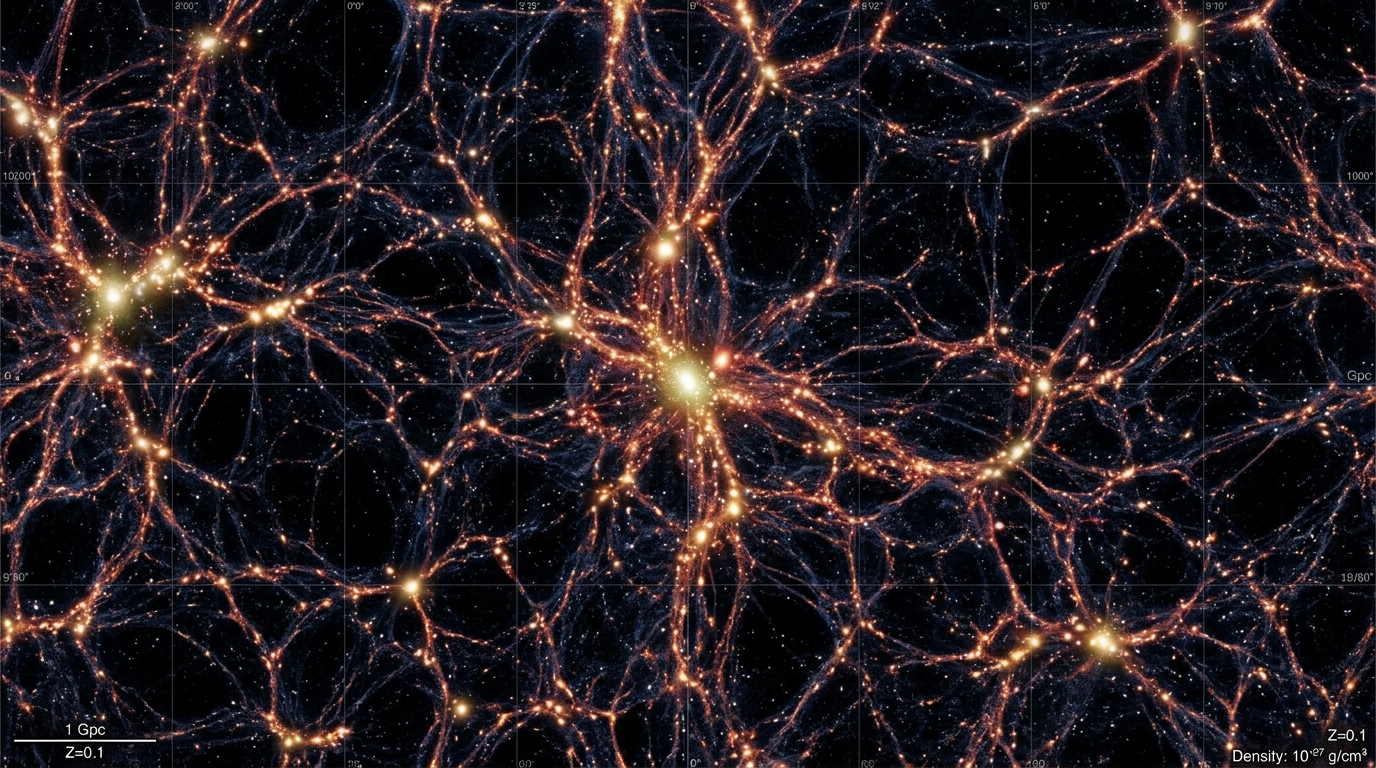
Vera Rubin's galaxy rotation curves and proved that 85% of cosmic matter is non-luminous '', forming a vast filamentary web that guides galaxy formation.
Historical & Cultural Context
In 1933, Fritz Zwicky noticed galaxies in the Coma cluster were moving far too fast to be held by visible stars alone, coining the term 'dunkle Materie' (). In the 1970s, Vera Rubin and Kent Ford measured flat rotation curves in spiral galaxies: outer stars orbit just as fast as inner stars, proving a massive unseen halo surrounds every galaxy.
The Proposed Model
Cold (CDM): non-baryonic, collisionless matter that interacts almost exclusively via gravity. collapsed under gravity into a filamentary 'cosmic web' of sheets, filaments, and nodes, inside which ordinary gas cooled to ignite the first stars and galaxies.
What Observations Supported It?
1. Flat galaxy rotation curves extending far beyond the visible starlight.
2. : massive galaxy clusters bend background starlight, allowing astronomers to map distributions directly.
3. The Bullet Cluster (1E 0657-56): during a collision between two clusters, hot gas collided and slowed, while passed straight through without friction, observed by Chandra X-ray and .
4. acoustic power spectrum peak ratios.
What Evidence Challenged or Refined It?
Despite extensive particle physics searches (LUX-ZEPLIN, XENONnT, CERN LHC), particles (WIMPs, axions, or sterile neutrinos) have not yet been directly detected in the laboratory.
What Changed Next?
While was pulling galaxies together, astronomers in 1998 made a shocking discovery: the overall expansion of the universe is not slowing down—it is accelerating.
Scientific Accuracy Note: Alternative theories such as MOND (Modified Newtonian Dynamics) attempt to explain flat rotation curves without dark matter by altering gravity at low accelerations, but struggle to reproduce the Bullet Cluster and the detailed CMB acoustic peaks.
Observation of spatial separation between normal gas and dark matter in colliding galaxy clusters.
Student Inquiry & Exam FAQGrade 10–11
Key conceptual questions for Chapter 21: Dark Matter & the Cosmic Web
CHAPTER 22·1998 CE
Cosmology & Big Bang
Accelerating Expansion & Dark Energy
The 1998 Supernova Revolution and the Repulsive Cosmos
Civilizations:United States, Australia, International
Key Observers:Saul Perlmutter (b. 1959), Brian Schmidt (b. 1967), Adam Riess (b. 1969), Supernova Cosmology Project & High-Z Supernova Search Team
Grade 10–11 Concept Spotlight (NASA & Wikipedia):
In 1998, two rival teams measuring distant Type Ia supernovae discovered that cosmic expansion is speeding up, driven by a mysterious smooth repulsive pressure dubbed ''.
Historical & Cultural Context
Cosmologists expected gravity to gradually slow the expansion of the universe. In 1998, the High-Z Supernova Team (led by Schmidt and Riess) and the Supernova Cosmology Project (led by Perlmutter) measured distances to distant Type Ia supernovae ('exploding white dwarf standard candles'). Both teams found the supernovae were ~20% fainter than expected—space had expanded faster than anticipated.
The Proposed Model
Accelerating cosmic expansion driven by ****, which contributes approximately 68% of the universe's total energy density. The simplest mathematical representation is Einstein's reinstated **cosmological constant** ($\Lambda$), representing a constant vacuum energy with negative pressure ($w = -1$).
What Observations Supported It?
1. Independent Type Ia supernova surveys over $z = 0.1$ to $z > 1.5$.
2. Baryon Acoustic Oscillations (BAO) measured by the Sloan Digital Sky Survey (SDSS) and DESI.
3. The acoustic peaks, which require a flat spatial universe ($"\Omega_k \approx 0"$) that cannot be accounted for by matter alone.
4. Growth of large-scale cosmic structure.
What Evidence Challenged or Refined It?
The physical nature of remains one of the greatest unsolved mysteries in all of science. Theoretical calculations of quantum vacuum energy yield a discrepancy of $\sim 10^{120}$ ('the worst prediction in theoretical physics').
What Changed Next?
The combination of , cold , and ordinary baryonic matter forged our current standard cosmological model: $\Lambda$CDM.
Scientific Accuracy Note: Dark energy does not overcome gravity within gravitationally bound systems (such as the solar system, Earth, or the Milky Way); its repulsive effect operates across cosmological scales where gravity between separated galaxy clusters is weak.
NASA's comprehensive guide to the evidence for dark energy and accelerating cosmic expansion.
Student Inquiry & Exam FAQGrade 10–11
Key conceptual questions for Chapter 22: Accelerating Expansion & Dark Energy
CHAPTER 23·21st Century
Contemporary Frontier
The Modern Standard Model (ΛCDM)
Precision Cosmology and the Concordance Universe
Civilizations:Global Scientific Community (NASA, ESA, ESO, DESI, JWST)
Key Observers:Jim Peebles, Planck Science Collaboration, Sloan Digital Sky Survey (SDSS), Dark Energy Spectroscopic Instrument (DESI)
Grade 10–11 Concept Spotlight (NASA & Wikipedia):
The Lambda-Cold (ΛCDM) model describes a 13.8-billion-year-old spatially flat universe consisting of 68.3% , 26.8% , and only 4.9% ordinary atoms.
Historical & Cultural Context
Over the past twenty-five years, data from space observatories (Hubble, WMAP, Planck, ) and ground surveys (SDSS, DES, DESI) converged on an extraordinarily consistent, parameter-constrained model of the cosmos.
Precision alignment across multiple independent cosmic tests: the angular scale of acoustic peaks, the distance scale of Type Ia supernovae, light-element yields, and 3D baryon acoustic oscillation surveys mapping tens of millions of galaxies.
What Evidence Challenged or Refined It?
The **Hubble Tension**: local measurements of the expansion rate using Cepheids and supernovae yield $H_0 \approx 73.0 \pm 1.0$ km/s/Mpc, while measurements from the early universe predict $H_0 \approx 67.4 \pm 0.5$ km/s/Mpc. This $5\sigma$ statistical discrepancy may point to new physics beyond $\Lambda$CDM.
What Changed Next?
Cosmologists must reconcile the finite observable universe accessible to our telescopes with the potentially boundless reality of the unobservable universe beyond.
Scientific Accuracy Note: All quoted percentages are derived from the European Space Agency Planck Collaboration 2018 final legacy cosmological parameter releases and are consistent with modern astrophysics standards.
Because the universe has a finite age of 13.8 billion years and light has a finite speed, we can only observe a finite bubble: the observable universe, currently ~93 billion light-years across.
Historical & Cultural Context
In an expanding universe, light emitted 13.8 billion years ago comes from matter that has since been carried much farther away by metric expansion. The particle horizon defines the boundary of the observable universe—the farthest distance from which light could have reached us since the Big Bang.
The Proposed Model
The **Observable Universe** is a sphere centered on the observer with a comoving radius of approximately **46.5 billion light-years** (diameter: **~93 billion light-years**, or $\sim 8.8 \times 10^{26}$ meters), containing an estimated **2 trillion galaxies**.
**CRITICAL SCIENTIFIC DISTINCTION**: The observable horizon is NOT a physical wall or the edge of all existence! It is simply an optical light-travel limit relative to Earth's vantage point. An observer located in a distant galaxy 40 billion light-years away sees their own 93-billion-light-year observable sphere overlapping with ours.
What Observations Supported It?
Relativistic cosmological kinematics derived from and verified by the of the ($z \approx 1100$).
What Evidence Challenged or Refined It?
We cannot receive electromagnetic signals from beyond the particle horizon. Whether the entire physical universe beyond our observable bubble is spatially finite (like a 3-torus) or mathematically infinite remains an open scientific question.
What Changed Next?
To peer as close to the horizon as physically possible, astronomers built revolutionary space telescopes that see across all wavelengths of light.
Scientific Accuracy Note: A common misconception is that the radius of the observable universe should be 13.8 billion light-years. Because space expanded during the 13.8 billion years the light was traveling, the original emitting gas is now located ~46.5 billion light-years away.
Scientific explanation of the 46.5 billion light-year comoving particle horizon and the expansion of the light cone.
Student Inquiry & Exam FAQGrade 10–11
Key conceptual questions for Chapter 24: The Observable Horizon
CHAPTER 25·1990–Present
Contemporary Frontier
The Universe Through Modern Telescopes
From Hubble and JWST to Gravitational Waves
Civilizations:International Alliances (NASA, ESA, CSA, ESO, LIGO-Virgo-KAGRA)
Key Observers:Hubble Space Telescope team, James Webb Space Telescope (JWST) team, Event Horizon Telescope (EHT) collaboration, LIGO-Virgo gravitational wave physicists
Grade 10–11 Concept Spotlight (NASA & Wikipedia):
By combining optical, infrared, radio, X-ray, and gravitational wave observatories, modern astrophysics perceives phenomena completely invisible to the human eye, from baby galaxies to black hole event horizons.
Historical & Cultural Context
For thousands of years, humans only observed a narrow sliver of visible light (400–700 nm). The 20th and 21st centuries opened the full electromagnetic spectrum: radio astronomy discovered pulsars; X-ray telescopes revealed black hole accretion disks; pierced cosmic dust to detect galaxies just 300 million years after the Big Bang ($z > 14$); and LIGO detected gravitational waves from colliding black holes.
The Proposed Model
The **Multiwavelength Universe**: physical processes emit across distinct energy bands:
- **Radio / Submillimeter (ALMA, EHT)**: Cool molecular clouds, protostellar disks, black hole shadow imaging (M87*, Sgr A*).
- **Infrared (, Spitzer)**: Dust-obscured stellar nurseries, exoplanet atmospheres, high- early galaxies.
- **Optical (Hubble, VLT)**: Stellar photospheres, galactic structures, ionized nebulae.
- **X-Ray & Gamma-Ray (Chandra, Fermi)**: Supernova remnants, neutron star accretion, supermassive black hole jets.
- **Gravitational Waves (LIGO, Virgo)**: Pure spacetime ripples from black hole and neutron star mergers.
What Observations Supported It?
Over 30 years of Hubble deep field surveys, the 2019 and 2022 Event Horizon Telescope images of black hole shadows, direct spectroscopy of exoplanet atmospheres (identifying carbon dioxide, methane, water vapor), and over 100 detected gravitational wave events.
What Evidence Challenged or Refined It?
Telescopes can only observe photons and waves that have reached our instruments. Deep cosmological mysteries remain unresolved behind observational boundaries.
What Changed Next?
These incredible observational tools have brought us face to face with the unresolved frontiers of 21st-century cosmology.
Scientific Accuracy Note: Astronomy images from non-visible wavelengths (infrared, X-ray, radio) are translated into 'representative color' (chromatically ordered from lowest frequency to highest) so human eyes can interpret physical data.
The global millimeter VLBI array that captured the first direct images of supermassive black hole shadows.
Student Inquiry & Exam FAQGrade 10–11
Key conceptual questions for Chapter 25: The Universe Through Modern Telescopes
CHAPTER 26·The Unresolved Horizon
Contemporary Frontier
The Current Frontier
What Humanity Still Does Not Know
Civilizations:Global Humanity & Future Generations of Scientists
Key Observers:Cosmologists, Particle physicists, You & the Next Generation of Explorers
Grade 10–11 Concept Spotlight (NASA & Wikipedia):
Every cosmological model was a way of asking a better question. Today, cosmologists confront profound mysteries: What is ? What is ? What happened at the earliest accessible moment?
Historical & Cultural Context
Humanity has mapped the observable universe across 13.8 billion years, yet 95% of the cosmos remains composed of dark components whose fundamental microphysics is unknown. Scientific humility reminds us that our current standard model, like all models before it, is an evolving approximation of a richer reality.
The Proposed Model
The Major Unresolved Questions of Modern Cosmology:
1. **What is ?** (A new supersymmetric particle, axions, primordial black holes, or modified gravity?)
2. **What is ?** (Einstein's vacuum cosmological constant, a dynamic quintessence scalar field, or a breakdown of on cosmic scales?)
3. **The Hubble Tension**: Why do early-universe measurements ($67.4 \text{ km/s/Mpc}$) disagree with late-universe local distance ladders ($73.0 \text{ km/s/Mpc}$)?
4. **What Happened at $t = 0$?** (Did the universe emerge from a singularity, a quantum bounce, or a pre-existing eternal multiverse?)
5. **Why is There Matter at All?** (Baryon asymmetry: why did the early universe produce more matter than antimatter instead of mutual annihilation?)
6. **Is the Entire Universe Finite or Infinite?** (What is the global topology of spacetime beyond our observable horizon?)
What Observations Supported It?
Active international experiments: the Spectroscopic Instrument (DESI), the Vera C. Rubin Observatory (LSST), the Nancy Grace Roman Space Telescope, the Euclid mission, and next-generation gravitational wave detectors (LISA).
What Evidence Challenged or Refined It?
Direct empirical observation is constrained by the speed of light, cosmic horizons, and the Planck scale ($10^{-35} \text{ m}$), requiring new mathematical frameworks uniting quantum mechanics with .
What Changed Next?
The next chapter in cosmic history will be written by future observers and thinkers who dare to question today's assumptions.
Scientific Accuracy Note: Science does not claim absolute finality; it constructs testable, empirically grounded models that are continuously refined, challenged, and transformed by new observations.
European Space Agency scientific framework targeting the nature of dark matter, dark energy, and fundamental physics.
Student Inquiry & Exam FAQGrade 10–11
Key conceptual questions for Chapter 26: The Current Frontier
The Unbroken Human Quest
We Have Mapped an Observable Universe. We Have Not Answered Every Question.
Every model was a way of asking a better question. From prehistoric megaliths to space-based gravitational wave observatories, the next picture of the cosmos may begin with something humanity has not yet understood.